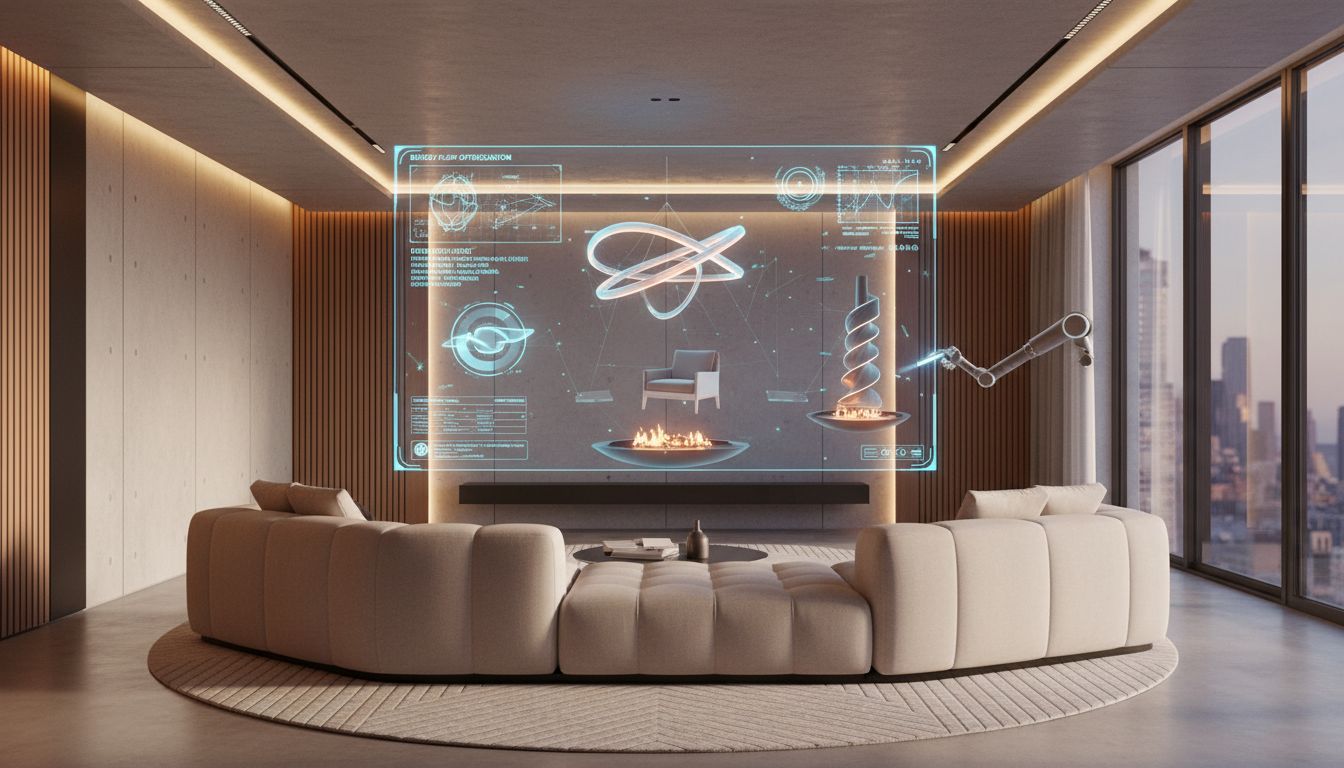
Five years ago, redesigning a room meant hiring an interior designer for $2,000 - $12,000, waiting weeks for mood boards, and hoping the final result matched what you imagined. Today, you can upload a single photo and get a photorealistic redesign in under 30 seconds.
That's the promise of AI interior design - and in 2026, the technology has matured far beyond novelty. Platforms like Deqor now handle everything from virtual staging and style transfer to full room remodeling previews, powered by the same generation of AI models that transformed creative industries worldwide.
Whether you're a homeowner planning a renovation, a real estate agent staging listings, or an architect exploring concepts - this guide covers everything you need to know about AI interior design in 2026.
What Is AI Interior Design?
AI interior design uses artificial intelligence - specifically computer vision, generative adversarial networks (GANs), and diffusion models - to analyze, understand, and redesign physical spaces from photographs. Instead of manually creating designs in software like SketchUp or AutoCAD, you provide a photo and the AI generates a new version of that space with your chosen modifications.
The technology goes beyond simple filters or overlays. Modern AI design platforms understand the spatial geometry of your room - where walls meet ceilings, how light falls across surfaces, what's a window versus a mirror. This understanding allows the AI to make changes that respect perspective, lighting, and physical constraints, producing results that look like professional interior photography rather than obvious digital manipulations.
Think of it as having a professional interior designer, a 3D rendering artist, and a real estate photographer working together - except the entire process takes 15 - 30 seconds instead of 2 - 6 weeks.
How It Differs from Traditional Design Software
Traditional interior design software (like RoomSketcher, Planner 5D, or Chief Architect) requires you to manually build a 3D model of your room, place furniture piece by piece, adjust lighting, and render the final image. This demands hours of work and technical skill.
AI interior design flips the process: you start with a real photo of your actual space - not a 3D model - and the AI handles everything. No floor plans, no manual measurements, no 3D modeling expertise. The input is a smartphone photo; the output is a photorealistic visualization of your transformed room.
How AI Interior Design Actually Works
While every platform implements the process slightly differently, the core workflow follows the same four stages. Here's how it works on Deqor's Smart Upload system - one of the most advanced implementations available today.
Upload Your Photo
You take a photo of any room, building exterior, or outdoor space with your smartphone or camera. The image can be virtually any quality - AI models in 2026 handle low-light shots, wide angles, and even slightly blurry photos remarkably well. On Deqor, you simply drag and drop or snap a photo directly.
AI Analyzes the Space
This is where the magic happens. The AI uses computer vision to identify and segment every element in your photo: walls, floors, ceilings, windows, doors, furniture, fixtures, lighting sources, and even decorative items. It maps the room's spatial geometry - understanding depth, perspective, and proportions. Deqor's Smart Upload goes a step further, automatically detecting room type, current style, lighting conditions, and suggesting relevant transformations.
Select Your Transformation
Choose what you want to change. This could be a full style overhaul (converting a traditional living room to modern minimalist), a targeted change (swap the hardwood floors for polished concrete), or a creative transformation (turn a daytime exterior into a stunning twilight shot). On Deqor, you can pick from 65+ use cases or describe your vision in plain language using the Chat module.
AI Generates Your Design
The AI generates a photorealistic image of your redesigned space. The best platforms produce results that are nearly indistinguishable from professional photography - maintaining correct perspective, realistic lighting, natural material textures, and physically plausible furniture placement. Most generations take 10 - 30 seconds.
The Technology Behind It
If you've heard of DALL-E, Midjourney, or Stable Diffusion, you already have a sense of the foundation. AI interior design builds on the same category of generative AI models, but with critical adaptations for architectural and spatial understanding.
Diffusion Models
The core engine behind most AI interior design tools is the diffusion model. These models learn by being trained on millions of images, gradually learning to "denoise" - essentially reconstructing images from randomness. During generation, the model starts with noise and iteratively refines it into a coherent image that matches your specifications.
What makes interior-design-specific diffusion models special is their training data. They've been fine-tuned on millions of interior photographs, architectural renders, and professional staging images - teaching them what real rooms look like, how materials reflect light, and how furniture interacts with space.
Image-to-Image Translation
Unlike text-to-image generation (where you start from a text prompt and create an image from scratch), AI interior design primarily uses image-to-image translation. Your uploaded photo serves as the structural reference. The AI preserves the room's geometry, perspective, window placement, and spatial layout while changing the aesthetic elements - materials, colors, furniture, lighting, and decor.
This is a much harder problem than text-to-image generation. The AI must simultaneously understand the 3D structure of the room from a single 2D image and then generate a new version that's both aesthetically different and spatially consistent.
Semantic Segmentation
Before the generative model does its work, a computer vision model performs semantic segmentation - identifying and labeling every pixel in your photo. It knows which pixels are "wall," which are "floor," which are "sofa," and which are "window with a view of a garden." This pixel-level understanding is what allows targeted changes: replacing just the flooring, or changing only the wall color while leaving everything else intact.
ControlNet & Architectural Conditioning
One of the breakthrough technologies that made AI interior design practical is ControlNet - a neural network architecture that conditions the generation process on structural inputs like depth maps, edge detection, and segmentation masks. This ensures the AI respects your room's architecture. The walls stay where they are. The ceiling doesn't suddenly become curved. Door frames maintain their proportions.
Advanced platforms like Deqor layer multiple ControlNet conditions simultaneously - combining depth estimation, canny edge detection, and semantic segmentation to achieve spatial fidelity that was impossible even two years ago.
What Can AI Interior Design Do?
The capabilities have expanded dramatically. In 2023, most AI design tools could do basic style transfer on living rooms. In 2026, the best platforms handle a comprehensive range of transformations across virtually any space type.
Full Room Redesign
Transform any room into a completely different style - modern, minimalist, Scandinavian, industrial, bohemian, and 24 other aesthetics.
Virtual Staging
Add furniture and decor to empty rooms for real estate listings. Proven to increase listing engagement by up to 40%.
Style Transfer
Apply specific design styles to existing rooms while preserving the layout and architecture.
Material & Color Swap
Change specific elements: hardwood to marble floors, white walls to navy, leather sofa to velvet - targeted precision editing.
Exterior Enhancement
Enhance building facades, landscaping, and outdoor areas. Includes sky replacement and twilight conversion.
Renovation Preview
See what structural changes - knocking out walls, adding islands, changing layouts - would look like before committing.
AI Chat Design
Describe your vision in natural language and let the AI interpret and generate designs. Available on Deqor's Chat module.
Deqor alone offers 65+ distinct use cases across interior, exterior, and commercial spaces - from pool design to commercial office layouts, garden redesign to bathroom remodeling.
AI vs Traditional Interior Designers
Let's be honest and fair about this comparison. AI interior design is an incredibly powerful tool, but it doesn't replace every function of a human interior designer. Here's a realistic side-by-side breakdown:
| Factor | AI Interior Design | Traditional Designer |
|---|---|---|
| Cost | $10 - $50/month | $2,000 - $12,000+ per project |
| Speed | 15 - 30 seconds per design | 2 - 6 weeks for concepts |
| Revisions | Unlimited, instant | 2 - 3 rounds, days apart |
| Style Options | 80+ styles, mix and match | Limited by designer expertise |
| Spatial Accuracy | Excellent for visualization | Exact measurements & CAD |
| Sourcing & Procurement | Not available | Full sourcing & trade pricing |
| Project Management | Not available | Full oversight & contractor mgmt |
| Physical Touch & Feel | Visual only | Material samples & site visits |
| Availability | 24/7, instant | Business hours, scheduling |
| Personalization | Prompt-driven customization | Deep client relationship |
When You Still Need a Human Designer
If you're doing a major renovation that involves structural changes, plumbing, or electrical work - you need a professional. If you need someone to source specific furniture, manage contractors, and oversee an installation - that's a human designer's domain. AI excels at the visualization and exploration phase. Many designers now use AI tools like Deqor as part of their own workflow, generating concepts faster and then applying their expertise to execution.
Who Uses AI Interior Design?
The user base has expanded far beyond tech-savvy early adopters. Here's who's using AI interior design in 2026 - and how:
Homeowners & Renters
The largest user segment. Homeowners use AI to preview renovations before committing - visualizing new kitchens, bathrooms, and living spaces without spending a dime. Renters use it to explore decor changes within their lease constraints.
Deqor for Homeowners ?Real Estate Agents & Brokers
Virtual staging is the killer use case. Instead of paying $300 - $800 per physically staged room, agents generate photorealistic staging for a fraction of the cost. Listings with virtually staged photos receive 40% more engagement on average (NAR 2025 Report).
Deqor for Real Estate ?Interior Designers & Architects
Professionals use AI to rapidly generate concept presentations for clients. What used to require hours of rendering in V-Ray or Lumion now takes seconds - allowing designers to present 10x more options in client meetings.
Deqor for Designers ?Contractors & Builders
Contractors show clients renovation previews to close more projects. "Here's what your kitchen could look like" is a far more powerful sales tool than a verbal description.
Deqor for Contractors ?Property Developers & Investors
Developers visualize finish options for properties under construction. Investors evaluate potential renovations on prospective purchases - estimating ROI before signing a single check.
Deqor for Architects ?How to Get Started with AI Interior Design
Getting started is surprisingly simple. Here's a three-step walkthrough using Deqor:
Upload Any Photo
Head to the Deqor Studio and upload a photo of any space. It can be a room, an exterior, a garden, a commercial space - anything. Smartphone photos work perfectly. Deqor's Smart Upload will automatically analyze the image, identify the space type, assess lighting conditions, and suggest relevant transformations.
Choose Your Transformation
Browse the suggested transformations or pick from 65+ options. Want to see your living room in a Japanese minimalist style? Done. Want to stage an empty bedroom for a listing? Select virtual staging. You can also use the Chat module to describe exactly what you want in natural language - "Make the walls warm terracotta, add a mid-century modern sofa, and replace the floor with light oak hardwood."
Generate & Refine
Hit generate and wait 15 - 30 seconds. Review the result and iterate - try different styles, adjust specific elements, or explore variations. Deqor lets you transform any space instantly - no design experience needed.
Common Misconceptions About AI Interior Design
Myth: "The results look fake and cartoonish"
Reality: This was true in 2022 - 2023. In 2026, the best platforms produce photorealistic results that are virtually indistinguishable from professional interior photography. Deqor uses state-of-the-art diffusion models fine-tuned specifically for interior and architectural photography, delivering results that pass the "would you know this isn't a real photo?" test.
Myth: "AI will replace interior designers"
Reality: AI handles visualization - seeing what's possible. Human designers handle execution - making it happen. The best interior designers are now using AI tools to work faster and present more options. The relationship is complementary, not competitive. Demand for human designers has actually increased alongside AI adoption, as more people become inspired to renovate.
Myth: "It's too expensive for regular homeowners"
Reality: AI platforms like Deqor cost a fraction of what a single session with a human designer costs - we're talking pennies on the dollar. For real estate professionals, the ROI is even more dramatic: virtual staging costs a tiny fraction compared to physical staging.
Myth: "You need a high-quality professional photo"
Reality: Modern AI models handle regular smartphone photos remarkably well. You don't need professional lighting, a wide-angle lens, or perfect composition. A standard iPhone or Android photo taken in reasonable lighting conditions is more than sufficient.
Myth: "It only works for living rooms"
Reality: Platforms like Deqor support any space: kitchens, bathrooms, bedrooms, offices, restaurants, hotel lobbies, building exteriors, gardens, pools, commercial spaces, and more. If you can photograph it, AI can redesign it.
The Future of AI in Interior Design
We're still early. The technology is evolving rapidly, and several transformative capabilities are on the horizon. Here's what's coming in the next 2 - 3 years:
3D Room Scanning & Digital Twins
LiDAR sensors in smartphones (already available on recent iPhones and iPads) will enable instant 3D room scanning. Instead of working from a single 2D photo, AI will have a complete 3D model of your room - enabling precise furniture placement, accurate material rendering from every angle, and the ability to "walk through" your redesigned space.
Augmented Reality Visualization
Imagine pointing your phone at your living room and seeing the AI-redesigned version in real-time through your camera. AR visualization will bridge the gap between digital renders and physical reality - letting you "see" your new design projected onto your actual walls, floors, and furniture before changing anything.
AI-Powered Shopping & Procurement
See a sofa in your AI-generated design? Future platforms will identify the exact product (or the closest real-world match) and link you directly to purchase it. AI will close the loop between "visualization" and "making it happen" - generating a complete shopping list with prices and links from the design render.
Real-Time Collaborative Design
Couples, families, and designer-client teams will co-create designs in real-time - making changes together and seeing results update instantly. Think of it as Google Docs for interior design, powered by AI generation that responds to everyone's input simultaneously.
Video & Walkthrough Generation
Beyond static images, AI will generate full video walkthroughs of redesigned spaces - allowing you to virtually "tour" your renovation before it happens. Some early implementations are already appearing, with platforms like Deqor exploring video generation capabilities.
Frequently Asked Questions
What is AI interior design?
AI interior design uses machine learning models to analyze a photo of your space and generate photorealistic redesigns. You upload a photo, describe your desired style or changes, and the AI produces a visualization showing what your room could look like - in seconds.
How accurate are AI interior design results?
Modern AI design tools produce highly photorealistic results that respect your room's existing structure, lighting, and proportions. While the AI generates plausible redesigns, always treat them as inspiration and planning tools rather than exact architectural blueprints.
Do I need design experience to use AI interior design tools?
No design experience is required. Tools like Deqor are built for homeowners, real estate agents, and anyone curious about redesigning their space. You simply upload a photo and describe what you want in plain language - the AI handles the rest.
Can AI interior design replace a human designer?
For visualization and ideation, AI is often faster and more affordable than a human designer. For complex renovation projects, structural changes, or projects requiring local contractor coordination, a human designer still brings irreplaceable expertise. Most people use AI to clarify their vision before hiring a professional.
What types of spaces can AI redesign?
AI interior design tools work across virtually any interior or exterior space: living rooms, kitchens, bathrooms, bedrooms, home offices, outdoor patios, commercial spaces, and more. The AI adapts to the specific characteristics of each room type.
How do I get the best results from AI interior design?
Use a clear, well-lit photo taken straight-on rather than at extreme angles. Natural daylight photos tend to produce the best results. Be specific in your description - instead of "modern," try "modern Scandinavian with light oak floors and white walls."
Is AI interior design useful for real estate?
Absolutely. Real estate agents use AI design for virtual staging (furnishing empty rooms), renovation previews (showing buyers a property's potential), and listing photo enhancement. Staged homes sell 73% faster than vacant ones, making AI staging one of the highest-ROI tools in real estate marketing.
How long does an AI interior design generation take?
Most AI design tools generate results in 15 - 45 seconds. Deqor typically produces photorealistic redesigns in under 30 seconds, allowing you to rapidly iterate through dozens of styles and options in a single session.
Written by Deqor Editorial
The Deqor editorial team covers AI design technology, interior design trends, and practical guides for homeowners and professionals. We test everything we write about.
Last updated: February 17, 2026 · Reviewed for accuracy by the Deqor product team