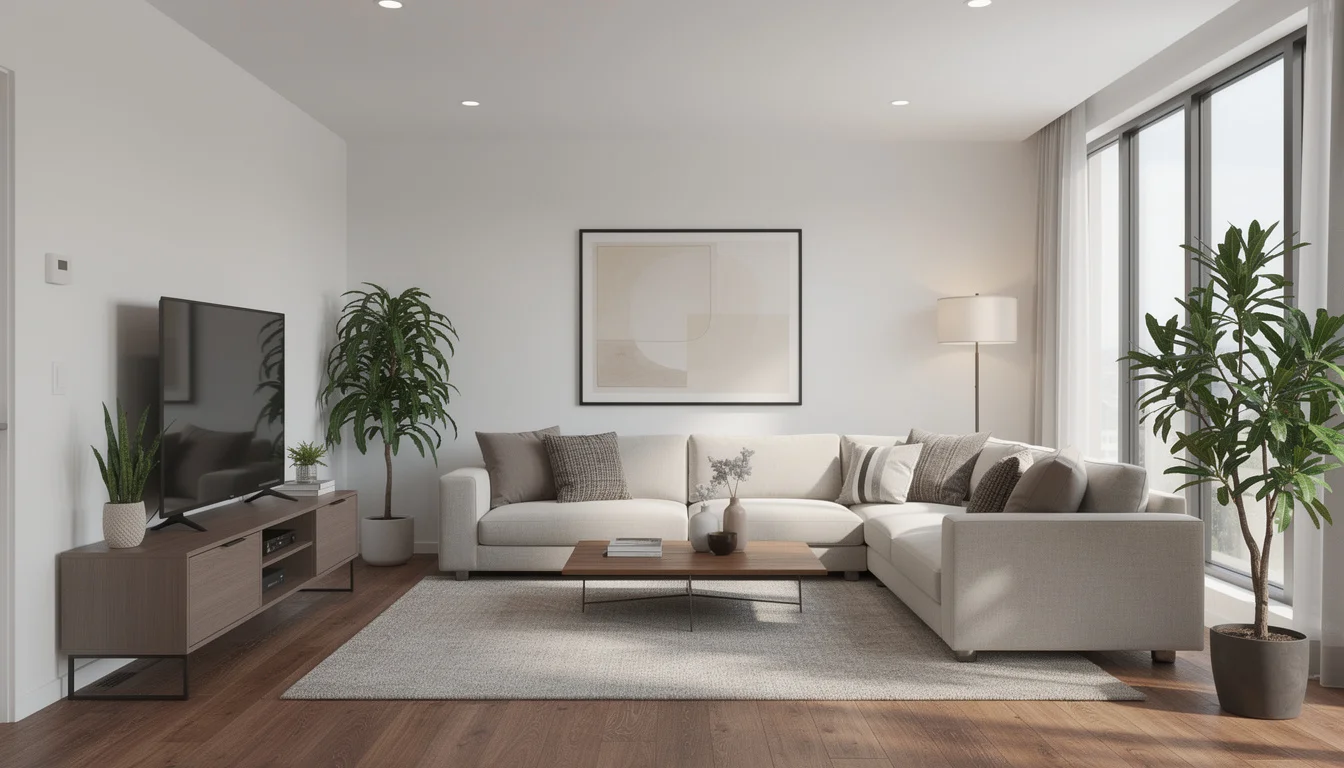
What Is Virtual Staging?
Virtual staging is the process of digitally adding furniture, decor, and design elements to photographs of empty or outdated rooms. Instead of renting physical furniture and hiring movers to stage a property (traditional staging), virtual staging achieves a similar visual result entirely through software - at a fraction of the cost, time, and logistical complexity.
The technology has evolved dramatically since its early days. First-generation virtual staging (2015 - 2020) used manual Photoshop work by graphic designers, producing results that often looked artificial - floating furniture, inconsistent lighting, and obvious digital artifacts. Second-generation tools (2020 - 2024) introduced template-based systems with pre-rendered furniture libraries. The current third generation, powered by AI, produces photorealistic results in seconds rather than hours, with natural lighting, accurate shadows, and design-coherent room compositions.
Virtual staging is used primarily in real estate, but its applications are expanding. Interior designers use it to show clients renovation possibilities. Homeowners use it to plan furniture layouts before buying. Property developers use it to pre-sell units. Even Airbnb hosts use virtual staging to visualize decor upgrades before investing. The core value proposition is the same: see what could be, before spending to make it real.
The virtual staging market reached $1.33 billion in 2026, growing at 25% annually. This growth is driven by real estate agents recognizing that staged listings sell 73% faster and for 5 - 10% more than vacant listings, according to the National Association of Realtors. When the cost of virtual staging is $1 - 50 per image versus $2,000 - $5,000 for physical staging, the math is compelling.
Virtual Staging Costs in 2026: The Complete Breakdown
Virtual staging pricing varies enormously based on the technology used, the level of customization, and the provider. In 2026, the market segments into three distinct pricing tiers, each serving different needs and budgets:
AI-Powered (Instant)
Fully automated AI generates staged rooms from empty photos. No human designer involved. Results in 10 - 30 seconds. Best for volume, speed, and cost-efficiency. Quality has improved dramatically - top AI tools now produce results indistinguishable from manual staging.
Hybrid (AI + Human)
AI generates the initial staging, then a human designer reviews and refines. Offers a balance of speed and customization. Some providers in this tier allow style requests, furniture brand placement, and specific design briefs.
Manual (Designer-Led)
A professional 3D artist or designer manually composes the staged room using rendering software. Maximum customization and control. Required for luxury listings or when specific furniture brands must be featured.
The dramatic price difference between AI and manual staging reflects the cost structure: AI staging has near-zero marginal cost per image (the AI model is already trained; generating one more image costs fractions of a cent in compute), while manual staging requires 1 - 3 hours of skilled designer time per image. For most real estate applications, AI-powered staging at $1 - 10 per image delivers more than sufficient quality and the speed advantage is decisive for fast-moving markets.
Pricing by Provider: 2026 Comparison
The virtual staging market has dozens of providers. Here's how the major players compare on pricing, speed, and quality in 2026:
| Provider Type | Price/Image | Speed | Quality |
|---|---|---|---|
| AI Platforms (Deqor) | Subscription | 10 seconds | Photorealistic |
| Budget AI Tools | $5 - 15 | 1 - 5 minutes | Good |
| Hybrid Services | $20 - 50 | 2 - 24 hours | High |
| Manual Staging Firms | $75 - 150+ | 24 - 72 hours | Premium |
| Physical Staging | $2,000 - $5,000/mo | 3 - 7 days | Real |
When evaluating providers, look beyond per-image pricing. Consider subscription costs, minimum commitments, revision policies, download resolution, usage rights, and whether the tool supports both staging (adding furniture) and redesign (transforming existing rooms). Deqor, for example, handles both virtual staging and complete room redesign through a single AI agent, making it versatile for real estate professionals who serve both vacant and furnished listings. Explore Deqor's real estate solutions for dedicated agent workflows.
AI Virtual Staging vs Traditional Physical Staging
The choice between virtual and physical staging depends on listing price, market conditions, and buyer expectations. Here's a comprehensive comparison to help you decide:
Cost
Virtual: $1 - 50 per room
Physical: $2,000 - $5,000/month rental
Virtual: 100 - 500x cheaper
Speed
Virtual: 10 seconds (AI)
Physical: 3 - 7 days setup
Virtual: instant results
Style Flexibility
Virtual: Unlimited styles, instant switch
Physical: One style per staging
Virtual: try any style instantly
Buyer Experience
Virtual: Photos only (no in-person staging)
Physical: Full in-person experience
Physical: tangible in-person impact
ROI
Virtual: 300 - 500% typical
Physical: 100 - 200% typical
Virtual: higher ROI on spend
Scalability
Virtual: Stage 100 listings simultaneously
Physical: Furniture limited to 3 - 5 at a time
Virtual: unlimited scale
The verdict for most agents: use virtual staging as your default for all listings, and reserve physical staging for luxury properties where in-person buyer experience justifies the 100x cost premium. For mid-market listings ($200K - $800K), AI virtual staging delivers superior ROI every time. For a deeper comparison, read our virtual staging vs traditional staging guide.
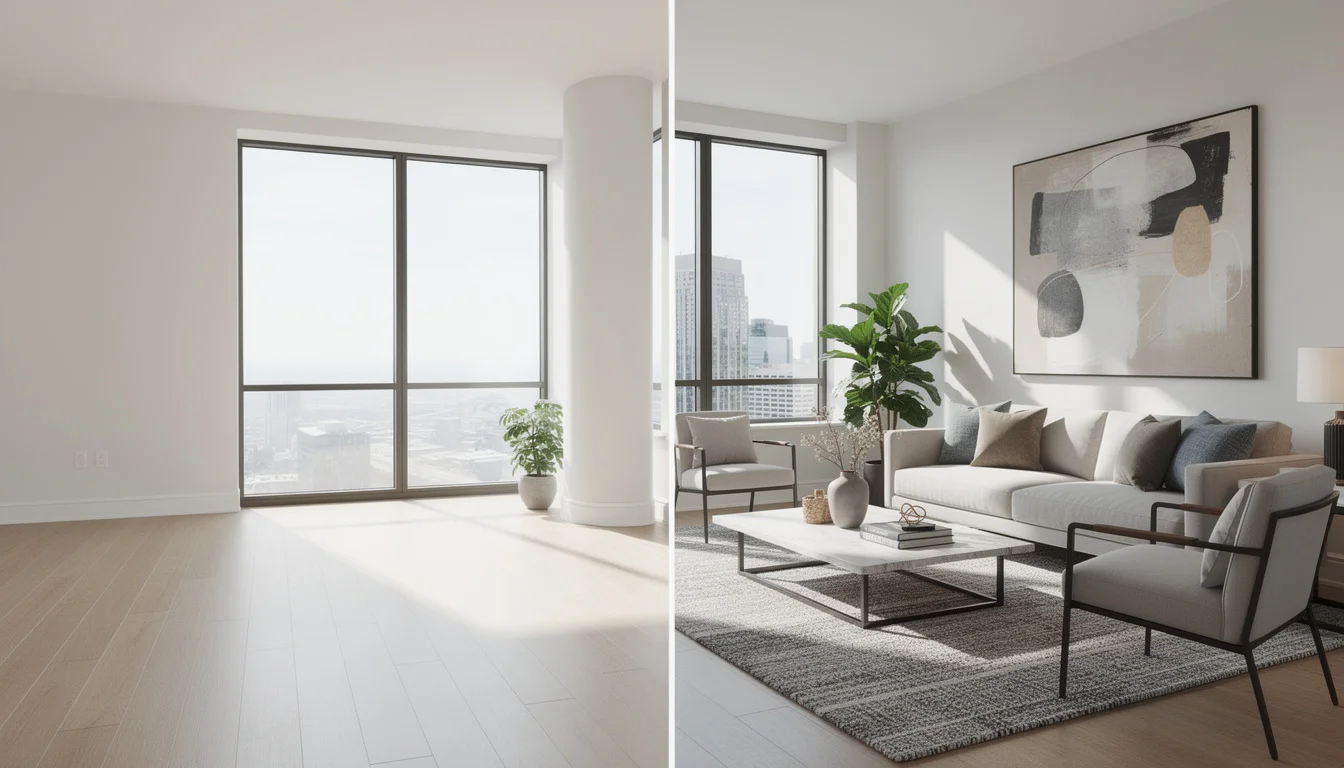
Virtual Staging ROI: The Numbers That Matter
The return on investment for virtual staging is one of the most compelling in all of real estate marketing. Let's walk through a realistic scenario to understand the math:
Example: $400,000 Listing
Virtual staging cost: 8 rooms · $2 = $16 total
Effect on sale price: +3% (conservative) = +$12,000
Effect on days on market: 73% faster sale (NAR data)
ROI: $12,000 · $16 = 75,000% return
Even using conservative estimates, the ROI is staggering. The National Association of Realtors reports that staged homes sell for 1 - 10% more than unstaged homes (with a median of 5%). Even at the low end - a 1% increase on a $400,000 home - that's $4,000 in additional sale price for a $16 virtual staging investment. The ROI is 25,000%.
Beyond sale price, virtual staging reduces days on market. Vacant listings average 30 - 45 more days on market than staged listings. Each additional day on market costs the seller in mortgage payments, taxes, insurance, and opportunity cost. For a $400,000 home, carrying costs average $50 - $80 per day. If virtual staging reduces time on market by even 15 days, that's $750 - $1,200 in saved carrying costs - still a massive return on a $16 investment.
For agents, the calculation extends further. Faster sales mean faster commissions, more time for new listings, and happier clients who refer. Top-producing agents report that virtual staging is their single highest-ROI marketing expenditure - not per-listing, but across their entire business.
Best Virtual Staging Tools in 2026
The virtual staging market has matured significantly, with clear leaders emerging in each category. Here are the top tools and platforms worth considering in 2026, evaluated on quality, price, speed, and ease of use:
Deqor
AI-Powered · Subscription plan
Full AI design agent that handles staging, redesign, and style transformation. 80+ styles, natural language chat, Smart Upload, and instant generation. Not just a staging tool - it's a complete design visualization platform for real estate and homeowners.
AI Staging Specialists
AI + Human Review · $15 - 35/image
AI-generated staging with human quality review. Good for agents who want a human check on every image. Slower than pure AI but adds a QA layer. Suitable for agents handling higher-end listings.
Manual Staging Studios
Designer-Led · $75 - 150/image
Professional 3D artists create custom staged rooms. Maximum customization, specific furniture brand placement, and luxury-level detail. Required turnaround is typically 24 - 48 hours. Best for luxury listings.
For a comprehensive review of all AI design tools including staging capabilities, see our best AI interior design tools guide.
How to Choose the Right Virtual Staging Tool
With dozens of virtual staging tools on the market, choosing the right one requires understanding your specific needs. Here are the key factors to evaluate:
Volume & frequency
How many images do you stage per month? If you list 5+ properties monthly with 5 - 10 images each, a subscription-based AI tool like Deqor is dramatically cheaper than per-image services. Calculate your monthly volume before comparing prices.
Speed requirements
Do you need staging results in seconds (for same-day listing photos) or can you wait 24 - 48 hours? AI tools deliver in seconds; manual services take days. For time-sensitive markets, speed is a competitive advantage.
Quality expectations
For listings under $500K, AI-generated staging is more than sufficient. For luxury listings ($1M+), consider hybrid or manual services. For ultra-luxury ($5M+), custom manual staging with brand-specific furniture may be expected.
Style variety
How many design styles do you need? AI tools typically offer 50 - 100+ styles. Manual services require a separate brief (and additional cost) for each style. If you serve diverse markets, style flexibility matters.
Integration with workflow
Does the tool integrate with your MLS, CRM, or marketing platform? Some tools offer API access for volume operations. Consider how the tool fits into your existing listing photography workflow.
Revision policy
What happens when you don't like the result? AI tools let you regenerate instantly. Manual services may charge for revisions. Understand the revision policy before committing, especially for per-image pricing models.
Virtual Staging Pricing by Room Type
Not all rooms are created equal when it comes to virtual staging impact and pricing. Some rooms benefit dramatically from staging while others see marginal improvement. Here's a room-by-room analysis to help you prioritize your staging budget:
| Room Type | AI Cost | Impact | Priority |
|---|---|---|---|
| Living Room | $1 - 2 | Very High | Stage first |
| Primary Bedroom | $1 - 2 | Very High | Stage second |
| Kitchen | $1 - 2 | High | Always stage |
| Dining Room | $1 - 2 | High | Always stage |
| Home Office | $1 - 2 | Medium-High | Stage if featured |
| Guest Bedroom | $1 - 2 | Medium | Stage for 3+ BR |
| Bathroom | $1 - 2 | Medium | Stage if empty |
| Outdoor/Patio | $1 - 2 | Medium | Stage if featured |
At AI pricing ($1 - 2 per room), the question isn't which rooms to stage - it's why wouldn't you stage every room? For $10 - 16 total, you can stage an entire 5 - 8 room home. The marginal cost of staging additional rooms is negligible compared to the potential impact on buyer perception and sale price.
Quality Comparison: AI vs Manual Staging
The quality gap between AI and manual virtual staging has narrowed dramatically. In a 2025 blind test conducted by Inman News, real estate agents were shown 50 pairs of staged images (one AI, one manual) and asked to identify which was AI-generated. The result: agents correctly identified the AI image only 52% of the time - essentially random chance. The quality has reached parity for the vast majority of applications.
Where manual staging still holds an advantage is in specific customization: placing a particular brand of furniture, matching an exact paint color to a client's request, or creating a highly specific interior design concept with exact material specifications. For these niche requirements, a skilled human designer can execute precise creative direction that current AI tools handle less consistently.
Where AI staging actually outperforms manual is in design coherence and trend awareness. AI models trained on millions of interior design images produce compositions that are inherently well-designed - they understand color theory, furniture proportion, spatial balance, and current trends. A mediocre manual stager might place furniture that clashes or crowds a room; AI consistently produces harmonious, market-appropriate compositions.
Getting Started with Virtual Staging
Ready to start virtually staging your listings? Here's the workflow that produces the best results:
Photograph Empty Rooms Properly
Shoot wide-angle photos from a corner, 4 feet high. Ensure rooms are clean, well-lit (open all blinds), and completely empty of debris. Straight walls and visible floors produce the best AI results.
Upload to Deqor
Use Deqor's Smart Upload to import your listing photos. The AI automatically detects room types and optimizes for staging. You can upload individual rooms or batch-upload an entire property.
Select Staging Style
Choose from 80+ design styles. For maximum buyer appeal, select styles that match the property's architecture and target buyer demographic. Modern for urban condos, transitional for suburban homes, luxury for high-end properties.
Review & Regenerate
Check the results. If a particular furniture placement doesn't work, regenerate - each attempt takes seconds. Generate 2 - 3 options per room and select the best.
Download & Deploy
Download staged photos in HD resolution. Add them to your MLS listing alongside (or replacing) empty room photos. Include a "Virtually staged" disclosure as required by your local regulations.
Legal & Ethical Considerations
Virtual staging is widely accepted in real estate, but it comes with disclosure requirements and ethical considerations that every agent must understand. Getting this right protects you legally and maintains buyer trust.
- Always disclose that images are virtually staged - most MLS systems require this in the photo description or listing remarks
- Do not alter structural elements (remove walls, add windows, change room sizes) as this constitutes misrepresentation
- Do not hide property defects behind virtually placed furniture - this can create legal liability
- Keep original unstaged photos available for comparison - some buyers and buyer agents will request them
- Follow your local MLS rules, which may specify exact disclosure language and placement requirements
- The NAR Code of Ethics requires "true picture" representation - virtual staging is compliant when properly disclosed
- Some states have specific regulations about digitally altered listing photos - check your state's real estate commission guidelines
- Virtual decluttering (removing personal items from photos) has different disclosure requirements than staging - understand the distinction
The key principle is transparency. Virtual staging enhances a property's presentation but should never misrepresent it. When buyers visit the property and find it matches their expectations (aside from the digitally added furniture), trust is maintained. When there's a disconnect between photos and reality, complaints and legal issues follow.
Frequently Asked Questions
How much does virtual staging cost per photo?
Virtual staging costs vary significantly: AI-powered subscription tools like Deqor give you unlimited staging at a flat monthly rate, hybrid AI+human services charge $15 - 50 per image, and manual designer-led staging runs $75 - 150+ per image. The vast majority of real estate agents now use AI-powered tools for the optimal quality-to-value ratio.
Is virtual staging worth it for real estate?
Absolutely. Staged listings sell 73% faster and for 5 - 10% more than vacant listings (NAR data). At $1 - 2 per image with AI tools, the ROI is extraordinary - even a conservative 1% sale price increase on a $300K home returns $3,000 on a $10 - 20 investment.
What is the best virtual staging tool in 2026?
For the best combination of quality, speed, and versatility, Deqor leads the AI-powered category - delivering photorealistic results in seconds with unlimited staging on a subscription plan. For luxury listings requiring brand-specific furniture, manual staging services remain the premium option at $75 - 150+ per image.
Can buyers tell if staging is virtual?
In blind tests, real estate professionals correctly identified AI staging only 52% of the time - essentially random chance. Modern AI staging produces photorealistic results with natural lighting, accurate shadows, and design-coherent compositions that are virtually indistinguishable from manual staging.
Do I need to disclose virtual staging?
Yes. Most MLS systems and state real estate commissions require disclosure that images are virtually staged. The standard practice is adding "Virtually staged" to the photo caption. Failure to disclose can result in MLS violations and potential legal liability.
How does AI virtual staging work?
You upload a photo of an empty or furnished room. The AI analyzes the space - identifying walls, floors, windows, and dimensions. It then generates photorealistic furniture and decor that matches the room's scale, lighting, and architecture. The entire process takes under 10 seconds with modern AI tools.
Can I virtually stage a furnished room?
Yes. AI tools like Deqor can both stage empty rooms (add furniture) and redesign furnished rooms (replace existing furniture with different styles). This "virtual redesign" capability is valuable for listings with dated or taste-specific decor that might not appeal to target buyers.
Virtual staging vs physical staging - which is better?
Virtual staging offers 100 - 500x lower cost, instant results, unlimited style options, and higher ROI. Physical staging provides a tangible in-person experience that virtual cannot replicate. For listings under $1M, virtual staging is the clear winner. For ultra-luxury listings, physical staging may be justified for the in-person buyer experience.
How many photos should I virtually stage per listing?
At AI pricing ($1 - 2 per image), stage every key room: living room, kitchen, primary bedroom, dining room, and any featured spaces. This typically means 5 - 8 images per listing for a total cost of $10 - 16. The living room and primary bedroom should be your top priorities.
Can virtual staging change wall colors or flooring?
AI tools like Deqor go beyond just adding furniture - they can transform wall colors, flooring materials, backsplashes, and more. This makes them valuable not just for vacant staging but for showing renovation potential to buyers who want to see the property's possibilities.
Written by Deqor Editorial
The Deqor editorial team covers virtual staging technology, real estate marketing trends, and pricing guides for agents and brokerages.
Last updated: March 22, 2026 · Reviewed for accuracy by the Deqor product team