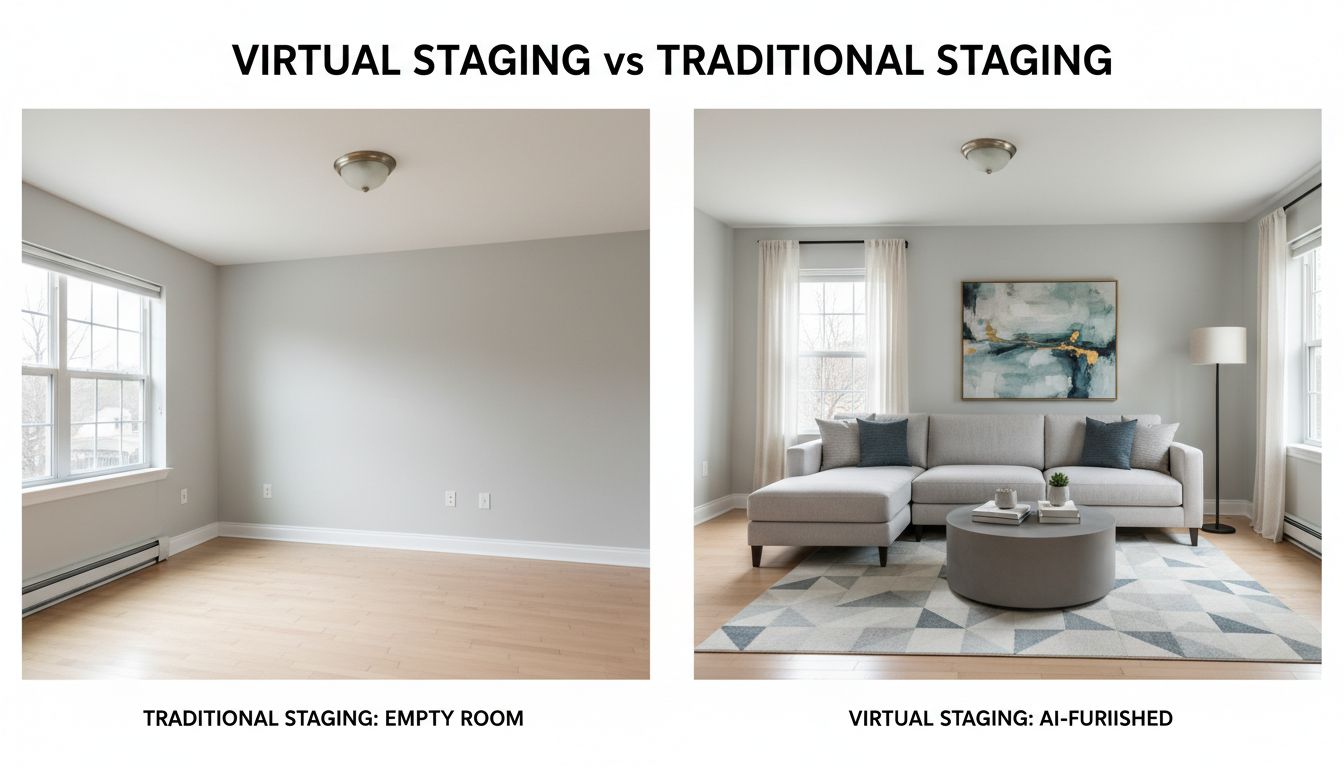
The home staging industry is worth an estimated $6.4 billion in the United States alone, according to the International Association of Home Staging Professionals (IAHSP). For decades, staging has been a proven strategy to sell homes faster and for higher prices. The National Association of Realtors (NAR) consistently reports that staged homes sell 73% faster than non-staged properties.
But the staging landscape is undergoing a seismic shift. The rise of AI-powered virtual staging has created a credible alternative that promises the same visual impact at a fraction of the cost and time. In 2026, real estate agents, homeowners, and property managers face a critical decision: stick with traditional physical staging, embrace virtual staging, or combine both.
This guide provides a comprehensive, data-backed comparison to help you make the right choice. We'll break down every factor that matters - from costs and timelines to buyer psychology and legal requirements - so you can stage smarter, not harder.
What Is Traditional Home Staging?
Traditional home staging is the practice of physically furnishing and decorating a property to make it more appealing to potential buyers. A professional stager (or staging company) brings in real furniture, artwork, rugs, lighting fixtures, plants, and decorative accessories to transform empty or poorly furnished rooms into aspirational living spaces.
The Traditional Staging Process
A typical traditional staging engagement follows a predictable path. First, there's a consultation - the stager walks the property, assesses each room, and develops a design plan. This alone costs $150–$600 depending on the market. Next comes furniture selection and delivery. The stager selects pieces from their inventory (or rents from a warehouse) and schedules delivery and setup, which typically takes 2–5 days for a standard 3-bedroom home.
After setup, the staging remains in place for the duration of the listing - typically 30–90 days for the initial period. Most staging companies charge a monthly rental fee on top of the initial setup cost. When the home sells (or the contract ends), the stager returns to de-stage - removing all furniture and accessories, which is another logistical event.
What Traditional Staging Costs
According to HomeAdvisor's 2025 data, the average cost to stage a home in the United States ranges from $2,000 to $5,000 for the initial setup, with monthly rental fees of $500–$1,500 depending on the amount of furniture and the local market. In high-cost markets like San Francisco, New York, or Los Angeles, full staging can exceed $10,000 for the initial period alone.
$2,000–$5,000
Initial setup cost
2–5 days
Setup timeline
$500–$1,500
Monthly rental fee
Traditional Staging by the Numbers
The data strongly supports traditional staging's effectiveness. According to the NAR's 2025 Profile of Home Staging report, 81% of buyers' agents said staging made it easier for buyers to visualize the property as a future home. 23% of sellers' agents reported an increase of 1–5% in the sale price of staged homes compared to similar non-staged properties. And staged homes spend 73% less time on market on average.
However, these compelling statistics come with an important caveat: the cost and logistical complexity of traditional staging makes it impractical for many listings, particularly lower-priced properties, rental units, or agents managing high volumes of listings simultaneously.
What Is Virtual Staging?
Virtual staging uses digital technology to add furniture, decor, and design elements to photographs of empty or under-furnished rooms. The result is a photorealistic image that shows what the space could look like when properly furnished - without physically moving a single piece of furniture.
The technology has evolved dramatically. Early virtual staging (2018–2022) relied on manual Photoshop work by graphic designers, who would cut and paste furniture from catalogs into room photos. The results were often unconvincing - shadows were wrong, perspectives were off, and the "pasted on" quality was obvious to discerning buyers.
In 2026, AI-powered virtual staging has changed the game entirely. Platforms like Deqor's virtual staging tool use advanced diffusion models and computer vision to understand the spatial geometry of a room, then generate furniture and decor that respects perspective, lighting, shadows, and reflections. The results are photorealistic - often indistinguishable from traditionally staged photography.
How AI Virtual Staging Works
Upload your property photo
Take a standard photo of the empty room with any smartphone or camera. No professional equipment required.
AI analyzes the space
The AI identifies walls, floors, windows, doors, and existing elements. It maps the room's 3D geometry from the single 2D photo.
Select a staging style
Choose from modern, traditional, Scandinavian, farmhouse, luxury, and dozens of other styles. Or describe your vision in plain language.
Get your staged photo
In 15–30 seconds, receive a photorealistic staged image ready for MLS listings, marketing materials, and online portals.
What Virtual Staging Costs
The cost difference is staggering. Traditional manual virtual staging (Photoshop-based) typically costs $75–$200 per photo with a 24–48 hour turnaround. AI-powered virtual staging ranges from $5–$50 per photo with near-instant results. On platforms like Deqor, a single subscription gives you access to unlimited virtual staging along with dozens of other AI design transformations - all included.
Head-to-Head Comparison
Here's a comprehensive side-by-side comparison across every factor that matters when choosing between virtual and traditional staging. We've assigned performance ratings based on industry data and expert consensus.
| Factor | Virtual Staging | Traditional Staging |
|---|---|---|
| Cost | Advantage$5–$50 per photo | Disadvantage$2,000–$5,000+ per home |
| Turnaround Time | Advantage15–30 seconds (AI) | Moderate2–5 days setup |
| Photo Quality | AdvantagePhotorealistic (2026 AI) | AdvantageReal photography |
| Flexibility / Iterations | AdvantageUnlimited styles & changes | DisadvantageOne design per staging |
* Ratings based on industry consensus, NAR data, and aggregate agent surveys. Individual results may vary by market.
Cost Breakdown: A Real-World Scenario
Let's make this concrete. Imagine you're staging a 3-bedroom, 2-bathroom home listed at $425,000 in a mid-sized US market. You want to stage the living room, master bedroom, kitchen, and one additional bedroom. Here's what each approach costs:
Traditional Staging
Timeline: 3–5 days setup + 2 months rental
Virtual Staging (Deqor)
Timeline: Under 5 minutes for all rooms
$4,900+ saved
per listing vs. traditional staging
For an agent staging 20 listings per year, the savings compound dramatically - freeing budget for marketing and growth.
The Volume Advantage
The math becomes even more compelling at scale. A busy real estate agent handling 20–30 listings per year would spend $98,000–$147,000 annually on traditional staging. With an AI virtual staging platform like Deqor, all staging is included in a single subscription - staging every listing costs a fraction of the traditional alternative. The freed-up budget can be redirected to marketing, advertising, or simply retained as additional profit margin.
This volume economics advantage is why virtual staging adoption among real estate agents has grown by 240% since 2023, according to a 2025 RealTrends survey. Agents aren't just saving money - they're staging every listing instead of selectively staging only their highest-value properties.
Quality Comparison: How Close Is Virtual to Real?
This is the question every real estate professional asks - and the answer has changed dramatically in just the past two years. Let's compare quality across several dimensions:
Photography Quality
Traditional staging produces real photographs of real furniture - there's no "digital" quality to spot. Professional photographers capture perfectly lit, composition-balanced shots that represent exactly what a buyer will see in person. The quality ceiling is defined only by the photographer's skill and the stager's design choices.
Virtual staging in 2026 has reached a level where trained real estate professionals have difficulty identifying AI-generated staging in blind tests. A 2025 study by the Real Estate Standards Organization (RESO) found that 78% of buyers could not distinguish between AI-staged and traditionally staged photos when viewing standard MLS listing images on their screens. The AI correctly handles perspective, lighting direction, shadow casting, material reflections, and color temperature matching.
Design Quality & Aesthetics
Traditional stagers bring professional design expertise - they understand buyer demographics, market preferences, and which furniture styles appeal to target audiences. However, they're limited by their available inventory. A stager with a modern furniture collection can't easily pivot to farmhouse or mid-century if the property calls for it.
Virtual staging is unconstrained by inventory. With Deqor, you can generate the same room in modern minimalist, Scandinavian, coastal, industrial, farmhouse, traditional, or any of 80+ design styles - instantly. This flexibility allows agents to tailor staging to the specific buyer demographic most likely to purchase the property.
Quality Perception: Buyer Survey Results
Source: RESO Virtual Staging Perception Study, 2025. n=2,400 home buyers.
When to Use Traditional Staging
Despite virtual staging's advantages, there are specific scenarios where traditional staging remains the superior choice. Here's when to invest in the real thing:
Luxury Properties ($500K+)
In the luxury market, buyers expect a premium in-person experience. A $1.5 million home with physically staged rooms creates an emotional connection that photographs alone - virtual or otherwise - simply cannot replicate. Luxury buyers are also more likely to attend multiple in-person showings and open houses, making physical presence essential. The staging cost represents a much smaller percentage of the sale price, making the ROI easier to justify.
Open House-Heavy Markets
In markets where open houses drive the majority of buyer traffic (common in suburban neighborhoods and certain metros), traditional staging shines. Buyers walk through rooms, sit on furniture, and experience the flow of the home. This tactile experience creates emotional attachment that no photograph - virtual or real - can fully substitute.
When to Use Virtual Staging
Virtual staging is the optimal choice in a wider range of scenarios than most agents realize. Here's where it delivers the strongest impact:
Vacant Properties
The #1 use case. Empty rooms photograph poorly - they look smaller, colder, and less inviting. Virtual staging transforms vacant spaces into warm, furnished rooms that help buyers visualize their future home. According to NAR data, vacant homes take 24% longer to sell than furnished ones. Virtual staging eliminates this disadvantage instantly.
Budget-Conscious Listings
For properties under $300K, spending $3,000–$5,000 on traditional staging may not pencil out. Virtual staging lets you get the same online marketing impact for under $30 - making it financially sensible to stage every listing regardless of price point.
Before-Renovation Planning
Use virtual staging to show buyers what a fixer-upper could look like after renovation. This is a powerful sales technique for investors and flippers. Deqor's renovation preview feature takes this further - learn more at our studio. Try it now →
The Hybrid Approach: Best of Both Worlds
Here's what top-performing agents are doing in 2026: they're not choosing one approach over the other - they're combining both strategically. The hybrid approach optimizes for both online marketing and in-person showings without breaking the bank.
Step 1: Virtual Staging for Online Listings
Use AI virtual staging (like Deqor's virtual staging) to create beautiful, fully staged photos for your MLS listing, Zillow, Realtor.com, social media, and other online marketing channels. Generate multiple style variations to A/B test which aesthetic resonates most with your target buyer demographic.
Step 2: Partial Physical Staging for Key Rooms
Instead of staging the entire home (4–6 rooms), physically stage just 1–2 hero rooms - typically the living room and master bedroom. This cuts traditional staging costs by 50–70% while ensuring buyers experience a "wow moment" when they walk in for a showing.
For our 3-bedroom example home: physically stage the living room and master bedroom ($1,500–$2,000), virtually stage the kitchen and second bedroom with AI. Total cost is dramatically less than full traditional staging - all while maintaining physical impact for the most important rooms.
Legal & Ethical Considerations
Virtual staging exists in a regulatory space that every agent must understand. Failure to comply with disclosure requirements can result in complaints, license issues, and potential legal liability. Here's what you need to know:
NAR Guidelines
The National Association of Realtors' Code of Ethics (Article 12) requires that agents present a "true picture" of properties. The NAR has clarified that virtually staged photos are permissible as long as they are clearly labeled. The recommended practice is to include a caption or watermark stating "Virtually Staged" or "Virtual Staging - Furniture Not Included" on all digitally altered images.
| State/Region | Requirement | Enforcement |
|---|---|---|
| California | Must disclose digital alterations in listings | DRE oversight |
| New York | Virtual staging must be labeled on all photos | DOS enforcement |
| Texas | Recommended disclosure (not codified in statute) | TREC guidelines |
Case Studies: Real Results
Data tells the story, but real-world examples bring it to life. Here are three case studies that illustrate the impact of virtual staging in different scenarios:
The Vacant Condo That Sold in 8 Days
A 2-bedroom condo in Austin, TX had been sitting vacant and unsold for 47 days with professional but empty-room photography. The listing agent decided to try virtual staging as a last resort before considering a price reduction.
47 → 8
Days on market (before/after staging)
+340%
Increase in listing views
AI
All rooms staged with AI
Frequently Asked Questions
Is virtual staging legal for real estate listings?
Yes. Virtual staging is legal in all 50 US states. However, most MLS systems, state regulations, and the NAR Code of Ethics require that virtually staged photos be clearly labeled. Always include a "Virtually Staged" label or watermark, and provide original unaltered photos alongside staged versions. Disclosure requirements vary by state - check your local regulations.
Do buyers feel deceived by virtual staging?
When properly disclosed, most buyers appreciate virtual staging as a helpful visualization tool. A 2025 Zillow survey found that 83% of buyers said virtually staged photos helped them better understand a space's potential. The key is transparency - always disclose, and always provide original photos. Problems arise only when staging is undisclosed or used to hide defects.
Can I use virtual staging on MLS?
Yes, most MLS systems allow virtually staged photos as long as they're labeled. Check your specific MLS guidelines - some require the label in the photo itself (watermark), while others accept a label in the photo description field. Major platforms like Zillow and Realtor.com also accept virtually staged images with proper disclosure.
Written by Deqor Editorial
The Deqor editorial team covers AI design technology, real estate marketing, and practical guides for agents, homeowners, and property professionals. Every claim in this article is sourced from industry data.
Last updated: February 25, 2026 · Reviewed for accuracy by the Deqor product team